

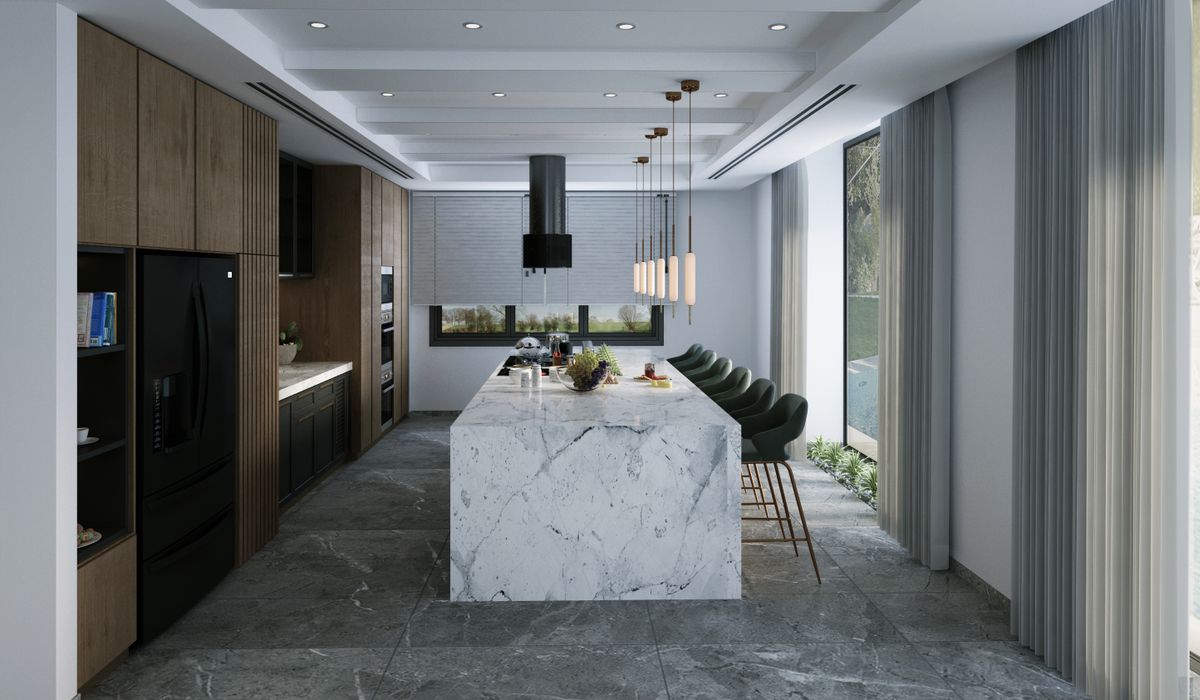
A pendant light is the one fitting in a dining room that everyone notices. It draws the eye the moment someone walks in, it defines the table as the heart of the room, and it does more to set the mood of a meal than almost anything else you can buy. It is also the fitting most often chosen by eye alone, then found to be a few centimetres wrong. Get the scale, the drop and the material right, and the result looks effortless.
Start with the size of the table, not the shade
The most common mistake is falling for a shade in a showroom and only afterwards working out whether it suits the table. Measure first. Proportions matter far more than style, and the rules are simple enough to use in a shop.
For a round or oval table, aim for a single shade with a diameter of roughly one-third to one-half of the table's diameter. A 120cm round table sits comfortably under a 40cm to 50cm shade. For a rectangular table, add up the diameters of the shades you are considering and aim for a total of about half the table's length. A 180cm table, for example, suits two 40cm shades or three 25cm ones. Below that, the fitting looks mean and lost; above it, the table feels crowded before the plates arrive.
Depth matters as much as width. A shallow, wide drum looks lighter than its diameter suggests, while a tall, narrow cylinder of 30cm or more can feel like a hanging column. If your table is on the narrow side, favour a flat shade over a deep one.
Getting the hanging height, and the cable length, right
For a table used for eating, the bottom edge of the shade should sit about 70cm to 80cm above the table top. In a room with high ceilings, or if you want a more dramatic look, 80cm to 90cm works well. Anything lower than 60cm will dominate the table and get in the way of serving dishes and conversation.
Now do the arithmetic before you buy, because many pendants arrive with a metre of cable that most rooms cannot use. Say your ceiling is 2.4m and your table is 75cm high. If the bottom of the shade is to hang 75cm above the table, it sits at 150cm from the floor. A shade 30cm tall puts the top of it at 180cm. That leaves just 60cm of cable between shade and ceiling. Look for an adjustable fabric cable of at least 1m, then shorten it neatly, and keep the offcut in case you move.
Your seated eyeline is the other measurement worth knowing. When you are sitting at the table, your eyes are roughly 115cm to 120cm from the floor, so a shade bottom at around 150cm sits comfortably above your sightline without glare. A bare bulb or an open-topped shade hung at 130cm will shine straight into your eyes all through dinner.
Shade material decides the mood
The material controls where the light goes, and that is what you actually experience at the table.
- Opaque metal and dark shades funnel light down into a pool on the table, leaving the ceiling in shadow. Dramatic and restaurant-like, but they need a dimmer or they can feel like a spotlight.
- Fabric, linen and pleated shades give the softest, most forgiving glow. Look for a diffuser across the base to hide the bulb.
- Opal glass and translucent acrylic produce an even, bright light that lifts a small room. Flattering, though sometimes a little flat.
- Clear glass shows the bulb entirely, so choose a decorative filament lamp and be certain you like looking at it.
- Rattan, bamboo, paper and ceramic add texture and cast gentle patterns on the ceiling. They are usually lighter too, which helps with ceiling fixings.
If you choose a dark shade, fit a slightly brighter bulb to compensate, as dark surfaces absorb a surprising amount of light.
One pendant, two, or three?
Position the fitting over the centre of the table, not the centre of the room. In many British dining rooms the table sits off-centre, and a pendant aligned to the ceiling rather than the table will look wrong forever.
For a long rectangular table, two or three smaller pendants usually beat one large one. Divide the table into equal sections and centre each pendant over its section, keeping them at identical heights. Odd numbers feel more relaxed than even ones, so three often reads better than two. A linear bar pendant or a single very long drum also works well over a long table and needs only one ceiling point.
The practical checks before you buy
- Check the ceiling rose will cover the existing hole, as many new fittings come with a small one.
- Weigh the shade. Anything over about 3kg should be fixed into a joist rather than plasterboard alone.
- Metal shades need an earth connection, so confirm your existing wiring has one. If in any doubt, use a registered electrician.
- If you want dimming, pair dimmable LED bulbs with a compatible trailing-edge dimmer and check its minimum load, or the lights may flicker at low levels.
- Note the bulb cap and maximum wattage: E27 and E14 are not interchangeable, and a shade with a small aperture may not take the bulb shape you had in mind.
Small rooms and low ceilings
If your ceiling is 2.2m or lower, choose a shallow, light-coloured, translucent shade and hang it at the upper end of the 70cm to 80cm range. A pale shade reflects light upwards and stops the ceiling feeling any lower. In a corner dining nook, a slim pendant or a pair of wall lights may be more comfortable than a central fitting. And if the table doubles as a desk or a craft space, a rise-and-fall pendant is worth the extra cost: pull it down for focused light, push it up for dinner.
Buy for the table you own, hang it so you can look across the room rather than into a bulb, and choose a material that flatters the food and the people around it. Then the pendant will simply look as though it was always meant to be there.



John Doe
14 January, 2022Having no content in post should have adverse..
Chauffina Carr
10 April, 2022We use these tests all time! Killer stuff!
Jim Séchen
16 July, 2022Thanks for all the comments, everyone!