

Why one ceiling light flattens a small room
Most small living rooms in British homes — the front room of a Victorian terrace, the lounge of a 1930s semi, that awkward space beside a chimney breast — are lit by a single pendant hanging from the middle of the ceiling. It is cheap to install, easy to live with, and it does exactly one job: it throws flat, even light downwards, leaving the corners in shadow and making a modest room feel smaller than it really is.
The fix is not to buy one brighter light. It is to build three layers — ambient, task and accent — and then control them separately. Light the room in bands rather than in one hit, and a compact space becomes warmer, more flexible, and noticeably deeper after dark.
Start with ambient: the soft base layer
Ambient light is the general wash that lets you move around safely and see the room as a whole. In a small living room, aim for soft and diffused rather than bright and direct. You want roughly 400–600 lumens for the whole space, not the 800–1,000 a bigger room would take.
- Replace a clear glass pendant with a fabric drum or linen shade in a pale tone. It spreads light sideways instead of burning a hot spot on the carpet.
- Choose a dimmable LED bulb at 2700K warm white. Cool white at 4000K will make even a nicely furnished room look like a waiting area.
- Consider two smaller pendants or a semi-flush fitting instead of one central pendant. Two sources at lower output read as calmer and more generous than a single bright one.
- Wall lights mounted around 1.7 metres from the floor, either side of a sofa or chimney breast, give you ambient light without eating floor space.
Add task light where you actually sit
Task lighting is the layer people most often skip, and it is the one that makes a small room genuinely usable. If you read, sew, work on a laptop or eat from a tray, you need light aimed at the job rather than poured from above.
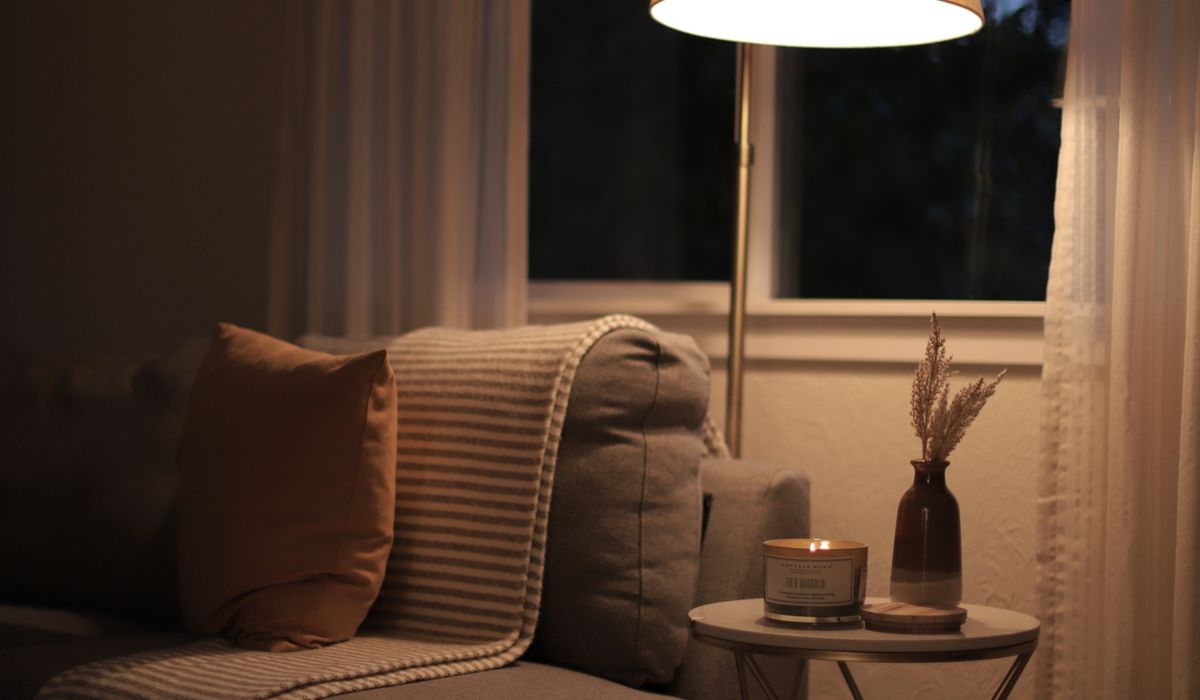
- A floor lamp with an adjustable head, positioned so the light falls over your shoulder onto the page, is the single most useful purchase in a small sitting room. Tuck the base behind the sofa arm or beside a chair.
- A table lamp on a side table should have its shade sitting roughly at eye level when you are seated, so you see the page and not the bulb.
- If floor space is tight, a swing-arm wall light or a clamp fitting on a shelf bracket does the same job without a base to trip over.
- Keep the switch within reach of where you sit. A lamp you have to get up to turn on will stay off.
Accent and glow: the layer that makes a room feel bigger
Accent lighting is where the magic happens in a compact room. When light washes a wall or grazes a surface, the eye reads depth and the room stops feeling like a box. This layer should be low, warm and deliberately uneven.
- An uplighter tucked into a corner, aimed at the ceiling, bounces soft light back down and lifts the height of the room.
- A small lamp on a bookshelf at around 200 lumens adds a pool of warmth at mid-height — exactly the level a single ceiling light leaves dark.
- Plug-in wall lights or a slim strip above shelving graze the wall and make it feel further away.
- A mirror opposite a lamp effectively doubles that light source. In a small room, this is the cheapest square footage you will ever buy.
- Candles count. Group three at different heights on a hearth or tray; they flicker at a colour temperature no bulb quite matches.
Get the practical bits right
The details decide whether layering works or just looks busy.
- Colour temperature: keep everything at 2700K, or 2200K for the accent layer. Mixing warm and cool bulbs in one room is the most common mistake.
- Dimming: fit dimmable bulbs and a trailing-edge dimmer, and check the dimmer is compatible with LED loads. A dimmer that buzzes will ruin the effect.
- Lumens, not watts: a 4W LED can easily match an old 40W filament bulb. Read the box for lumens.
- Switching: put lamps on a five-amp socket controlled by the wall switch, or use smart plugs, so you can turn the whole scheme on and off from the door.
- Renters: plug-in wall lights, adhesive cable clips and floor lamps need no drilling and leave no marks.
- Cables: never run flex under a rug where it can overheat. Use surface trunking along skirting instead.
A sensible order to buy in
If you are doing this gradually, spend in this order. First, a dimmable ambient source with a warm bulb — this alone transforms the room. Second, one good reading or task lamp placed where you sit most. Third, two small accent sources, such as an uplighter and a shelf lamp, on separate switches or plugs. Fourth, wall lights or a picture light if the budget stretches.
One last tip on scale: in a small room, a slightly taller floor lamp with a slim shade looks more elegant than a squat one, and a shade roughly 30–35cm across is about right for a side table. Buy the lamp before the shade where you can, and test bulbs in the room at night before committing to a set. Light is the one thing in a small living room you can change without moving a single wall.



John Doe
14 January, 2022Having no content in post should have adverse..
Chauffina Carr
10 April, 2022We use these tests all time! Killer stuff!
Jim Séchen
16 July, 2022Thanks for all the comments, everyone!