

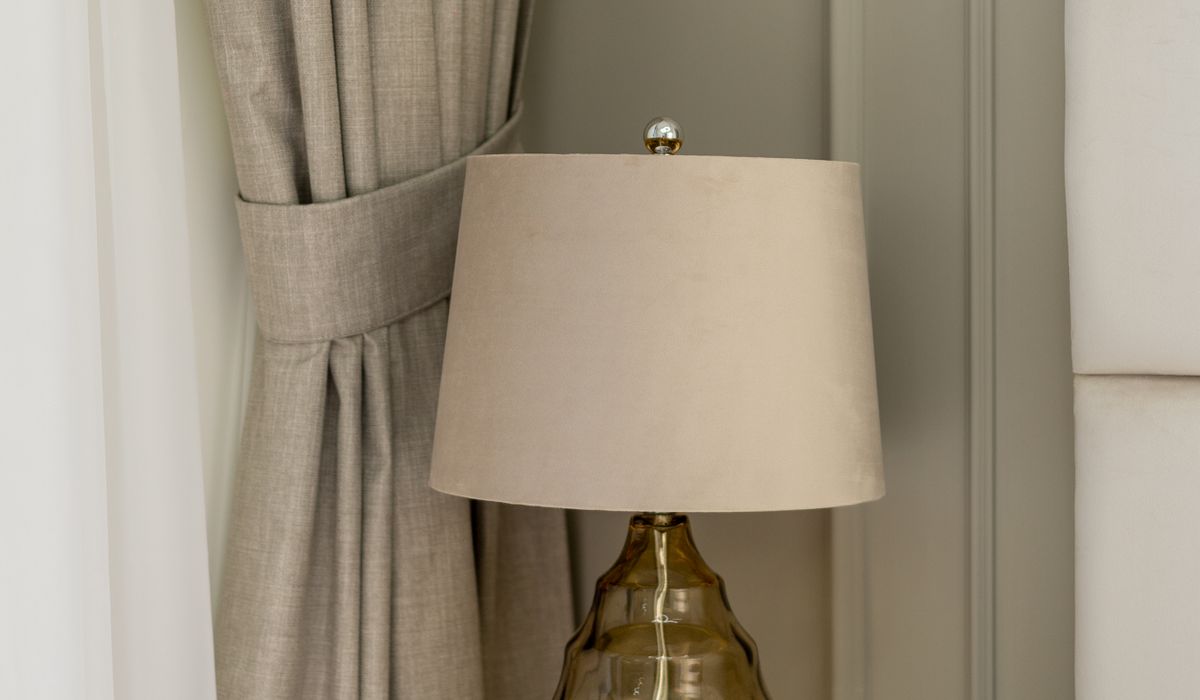
Why the ceiling light is the enemy of a good night's sleep
Most British bedrooms are lit by a single pendant hanging from the middle of the ceiling, and it is the worst possible arrangement for two people with different bedtimes. A modest 800-lumen bulb floods the whole room, including the face of the person who turned over ten minutes ago. Even closing your eyes doesn't help much — eyelids let a surprising amount of light through, and bright light suppresses melatonin, the hormone that tells your body it's time to sleep.
The answer isn't reading in the dark, and it certainly isn't propping a phone on the pillow. It's localising the light so it falls on the page and nowhere else. Get that right and one of you can read for an hour while the other sleeps soundly beside you.
Directional wall fittings do the heavy lifting
A fixed bedside table lamp shines outwards and upwards, throwing a soft glow across half the room. A directional wall light does the opposite: it aims a narrow pool of light down onto your book, keeping the spill behind your shoulder. The main options worth considering are:
- Swing-arm wall lights. The classic reading light, with a folding arm and a tilting head. Most take an E14 or E27 bulb, so you can choose exactly how dim you want it. Look for a switch on the backplate rather than one on the flex.
- Integral LED reading lights. Slim, neat and often no more than 3–5W. Many have a small tilting and swivelling head, run almost cold, and come in finishes that suit period properties as well as new builds.
- Wall-mounted spots on a bracket. Cheap and effective if you fit a narrow-beam GU10 (25–36 degrees). Avoid wide 60-degree lamps — they wash the whole wall and defeat the point.
- Clip-on or headboard-mounted fittings. Ideal if you rent and can't chase walls. Choose one with a padded clamp and a flexible gooseneck.
Get the brightness and colour temperature right
This is where most people go wrong. Ignore wattage and shop in lumens. For reading in bed you want roughly 100 to 250 lumens at the page — that's a fraction of a typical room bulb. A 4W LED at 2700K, replacing an old 40W incandescent, is usually plenty.
Just as important is colour temperature. Warm white, somewhere between 2200K and 2700K, keeps the room feeling calm and is far less disruptive to the sleeper. Cool white and daylight bulbs (4000K and above) are for kitchens and workshops, not for a darkened bedroom at half past eleven. If you're buying lamps with integrated LEDs, check the figure on the box before you commit — some "warm white" claims are optimistic.
Positioning in small British bedrooms
Space is tight in most homes, and a Victorian terrace bedroom with a chimney breast and a low ceiling leaves little room for manoeuvre. A few rules of thumb that save a lot of trial and error:
- Mount the fitting roughly 60–75cm above the top of the mattress, so the light falls onto the page and not into your eyes.
- Place it slightly forward of the reader's shoulder, angled down and back towards the book. That way the light beam travels away from your partner.
- Keep it at least 10cm clear of the headboard if it has a tilting head, so you can swing it without clunking the wood.
- On solid brick or lath-and-plaster walls, use a masonry bit and proper wall plugs. On plasterboard, find the stud or use a heavy-duty cavity fixing — a swing-arm lamp pulls harder than you'd think.
Switching, dimming and keeping the peace
One shared switch on the wall is no good: the click will wake a light sleeper every time. Choose fittings with individual switches on each backplate, or a small touch dimmer built into the head. If the lamp is dimmable, pair it with a trailing-edge dimmer rather than an old leading-edge type, which can buzz audibly at low levels.
For renters, rechargeable or USB-powered reading lights avoid any wiring at all, and adhesive cable clips keep the flex tidy along the skirting. A short braided cable in a colour that matches your wall disappears nicely — no chasing, no plaster dust, no landlord conversations.
A practical buying checklist
- Directional head that tilts and swivels, with enough friction to stay put.
- 100–250 lumens per reading light, ideally dimmable below that.
- Warm white, 2200–2700K, on both sides of the bed.
- Separate switching for each person, or a touch dimmer on the head.
- Beam angle under 40 degrees if you're using GU10 spots.
- Bulb type you can replace — E14 and E27 give you far more choice later than sealed integrated LEDs.
- Finish and size to match your room, especially in period properties where a chunky modern fitting looks out of place.
Get these basics right and reading in bed stops being a negotiation. Two small, well-aimed pools of warm light, each under its own control, and you can both do exactly what you like.



John Doe
14 January, 2022Having no content in post should have adverse..
Chauffina Carr
10 April, 2022We use these tests all time! Killer stuff!
Jim Séchen
16 July, 2022Thanks for all the comments, everyone!