

Ingress protection (IP) ratings are the unsung heroes of safe lighting. They tell you whether a fitting will survive steam, splashes, rain, or a dunking. Get them wrong and you risk flickering lights, tripped circuits, or worse. This guide explains what the numbers mean, where each rating belongs, and how to choose confidently for British homes.
What an IP rating actually tells you
IP is followed by two digits. The first digit shows protection against solid objects, from 0 (no protection) to 6 (dust tight). The second digit shows protection against liquids, from 0 (none) to 8 (immersion beyond 1 metre). So IP44 means protected against solid objects over 1mm (such as wires and tools) and splashing water from any direction. IP65 means dust tight and protected against water jets. IP68 means dust tight and protected against continuous immersion. An X in place of a digit, like IPX4, means the fitting was not tested for that category. For bathrooms, you often see IPX4 because dust is not a concern. For outdoors, you want both digits. Remember that an IP rating is not a measure of build quality or light output. A higher number is not automatically better; it simply means more resistance to solids and liquids. Choose the rating that matches the location, not the highest number on the shelf.
Bathroom lighting: the zones and what they demand
Bathrooms are divided into zones under UK wiring regulations (BS 7671). Zone 0 is inside the bath or shower tray. It requires IPX7 (immersion) and extra-low voltage (SELV, usually 12V). Zone 1 is directly above the bath or shower, up to 2.25 metres from the floor. It requires IPX4, or IPX5 if the fitting is subject to water jets. Zone 2 extends 0.6 metres beyond zone 1 and up to 2.25 metres high. It also requires IPX4. Outside these zones, there is no IP requirement, but an RCD is strongly recommended. In practice, a ceiling light above a shower should be IP44 or IP65. A wall light beside a basin (outside the zones) can be IP20, but IP44 gives extra peace of mind. Never fit an IP20 light in zone 1 or 2; it will fail. Also, note that IP ratings do not cover steam. Steam is a gas, and it can penetrate seals that stop liquid water. So even an IP44 fitting can suffer internal condensation. Choose sealed units or models designed specifically for bathrooms. Use IP44 as your minimum for most bathroom locations, and IP65 for directly over a shower or bath if jets are likely.
Outdoor lighting: from porch to pond
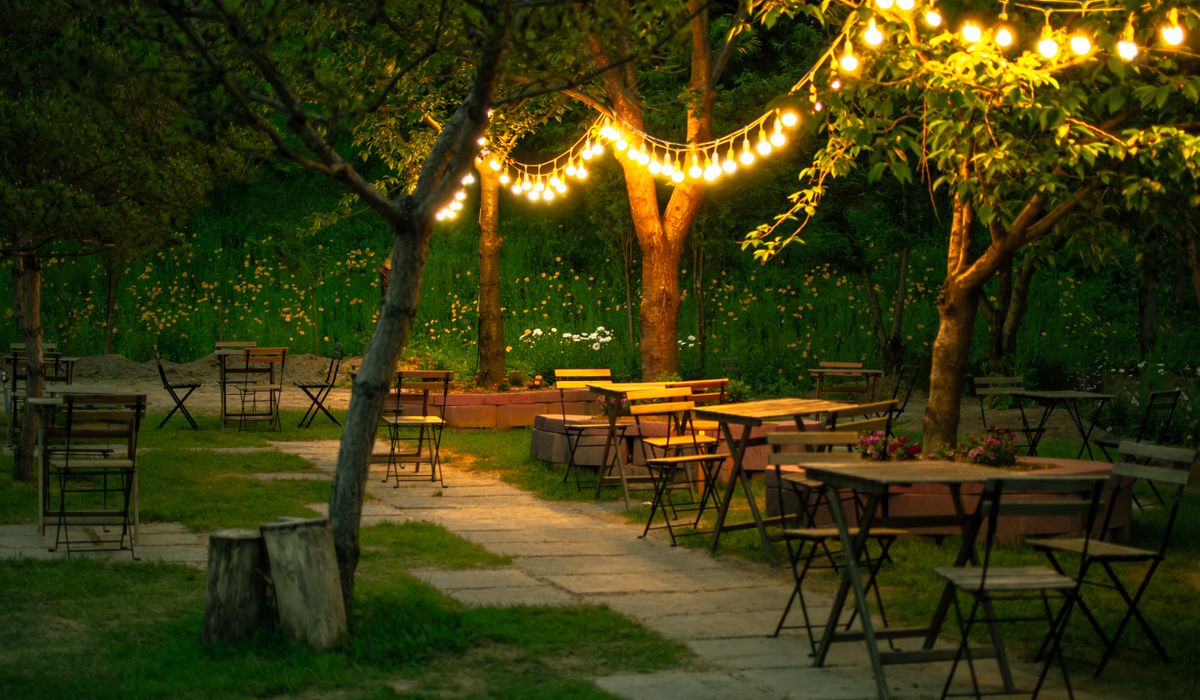
Outdoors, your lighting faces rain, hose jets, and occasional flooding. For a sheltered porch or under an eaves, IP44 is usually sufficient. For an exposed garden wall, choose IP65. For ground-level uplights or deck lights, where water can pool, go for IP67 or IP68. Pond lights must be IP68. Garden spike lights should be IP65 or IP66. Festoon lights vary: IP44 for a covered pergola, IP65 for open exposure. Remember that outdoor sockets should be IP66, but that is a separate matter. Also consider UV degradation. Plastics can become brittle and crack, so look for UV-stabilised materials or metal bodies. Cable entries matter as much as the rating. A fitting may be IP65, but if the cable gland is loose or missing, water will get in. Use IP65 as your default for any fitting that gets direct rain. For a covered patio, IP44 is acceptable, but IP65 will last longer.
Practical buying guide: matching fittings to places
- Bathroom ceiling (zone 1): IP44 or IP65, sealed diffuser, warm white 2700K–3000K.
- Bathroom mirror light (zone 2): IP44, integrated shaver socket if needed.
- Outside front door (sheltered): IP44, dusk-to-dawn sensor optional.
- Exposed garden wall: IP65, die-cast aluminium or stainless steel.
- Decking or patio ground: IP67, recessed or surface-mounted, with drainage.
- Pond or water feature: IP68, low voltage (12V) for safety.
Also check the first digit for outdoor use. IP6X means dust tight, which stops insects and dirt. For bathrooms, IPX4 is often enough because dust is not a big issue. But for a garage or workshop, IP6X is useful. Do not assume a higher number is always better. An IP68 fitting may be bulky and expensive, and if you do not need immersion, IP65 is more practical. IP ratings also do not cover corrosion. Coastal homes need marine-grade stainless steel or polycarbonate. Inland, powder-coated aluminium is fine.
Installation and maintenance tips
Always isolate the circuit before fitting. Use a 30mA RCD for all outdoor and bathroom circuits. For zone 0 and 1, use SELV with the transformer located outside the zone. When installing outdoor lights, create a drip loop in the cable before it enters the fitting. Use silicone sealant around cable entries if the gland is not enough. Check that the IP rating is maintained after installation. If you break a seal to change a bulb, replace the gasket. Clean bathroom lights with a dry cloth, not a wet one, to avoid pushing water into seams. For outdoor lights, check annually for cracked lenses or perished rubber seals. Replace any fitting that shows water inside. A cheap IP44 fitting that fails after a year is more expensive than a good IP65 one that lasts a decade. IP ratings are tested in laboratory conditions. Real life includes wind-driven rain and steam, so always choose a rating one step higher than the minimum if the fitting is in a challenging spot.



John Doe
14 January, 2022Having no content in post should have adverse..
Chauffina Carr
10 April, 2022We use these tests all time! Killer stuff!
Jim Séchen
16 July, 2022Thanks for all the comments, everyone!