


Why colour temperature matters more than you think
Walk into a room lit by a cheap, bluish bulb and you will notice something is off before you can name it. The colour temperature of a bulb — measured in kelvin (K) — has more effect on how a room feels than almost anything else you can change. Two bulbs might both be labelled "white", yet one will make your sitting room feel like a hotel lounge and the other like a dentist's waiting area.
Here is the short version. The lower the kelvin number, the warmer and more amber the light. The higher the number, the cooler and bluer it becomes. For a typical British home, most rooms sit happily between 2700K and 4000K, and the decision usually comes down to one question: do I want this room to feel relaxed, or alert?
Warm white: the comfort choice for living rooms and bedrooms
Warm white sits at around 2700K to 3000K. It is the closest match to the old incandescent bulbs many of us grew up with, and it flatters almost everything: wood, paintwork, fabric, skin tones. If you want a room to feel inviting at seven in the evening in the middle of a grey January, this is your light.
Warm white is the natural default for:
- Living rooms — table lamps at 2700K, with ceiling light on a dimmer for evenings.
- Bedrooms — especially bedside lamps, where cooler light can feel harsh and, frankly, wake you up.
- Dining rooms — warm light makes food look appetising and conversation feel easy.
- Hallways and landings — a welcoming glow rather than a corridor of scrutiny.
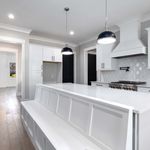
One tip worth knowing: if you like a clean, modern look but find 2700K a little too yellow, try 3000K. It is the quiet middle ground that suits contemporary kitchens and open-plan living spaces without tipping into clinical.
Cool white: crisp, alert light for kitchens and utility rooms
Cool white starts at roughly 4000K and runs up to about 5000K. It is brighter-feeling, sharper on detail, and it makes whites look genuinely white — which is exactly what you want where you are chopping vegetables, sorting laundry, or looking for a matching pair of socks.
Cool white earns its place in:
- Kitchens — under-cabinet strips and ceiling downlights at 4000K make worktops feel clean and tasks easier.
- Utility rooms and garages — practical, unfussy light for sorting, ironing and DIY.
- Home offices — 4000K during the working day helps you stay focused, particularly in winter.
- Bathrooms and en-suites — where you want to see clearly for shaving or applying make-up.
What you should avoid is pushing past 5000K in living areas. Anything above that heads towards "daylight" bulbs, which look blue and can feel cold even in a bright room. They have their uses in workshops and in task lamps, but rarely above the sofa.
A room-by-room guide for a typical British home
- Sitting room: 2700K throughout, dimmable, on two or three circuits so you are not lighting the whole room at once.
- Kitchen: 4000K ceiling downlights, 4000K under-cabinet strips, and 2700K pendants over a breakfast bar if you have one.
- Bedroom: 2700K, with a brighter 4000K lamp only if you read or work in bed.
- Bathroom: 4000K for mirrors and shaving, 3000K for a relaxing bath-time circuit.
- Hall, stairs and landing: 3000K is a good compromise — warm enough to welcome, bright enough to see the top step.
- Utility, garage, loft: 4000K or 5000K, and plenty of lumens.
What to check on the box before you buy
Colour temperature is only half the story. In a UK shop or online listing, look for these details:
- Lumens, not watts. A 9W LED at roughly 800 lumens replaces an old 60W bulb; around 1500 lumens replaces a 100W. Watts now tell you running cost, not brightness.
- Cap type. Most British ceiling pendants take a bayonet cap (B22), while many lamps and wall lights use a screw fitting (E27). Kitchen downlights are usually GU10. Measure or check before you order a box of ten.
- Dimmable or not. If your switch has a dimmer, buy dimmable LEDs and check the dimmer is LED-compatible, or you will get flicker and buzz.
- Colour rendering (CRI). Look for CRI 80 or above, ideally 90 in kitchens and bathrooms, so colours look true.
- Beam angle. Narrow spots for highlighting, wider beams for general light.
Mixing warm and cool light without making a mess of it
Open-plan living means you can often see the kitchen, dining area and sofa from one spot. Two very different colour temperatures in the same sightline can look accidental. The fix is simple: keep one temperature as your baseline across the whole space, then use the other sparingly for tasks. A 3000K baseline with 4000K under-cabinet lighting reads as deliberate; 2700K ceiling lights next to 5000K downlights reads as a mistake.
Finally, buy one bulb first and try it in the fitting before committing to a full set. Light behaves differently against your walls, your flooring and your furniture than it does in a shop display. Ten minutes of testing will save you a cupboard full of bulbs you never quite liked.





John Doe
14 January, 2022Having no content in post should have adverse..
Chauffina Carr
10 April, 2022We use these tests all time! Killer stuff!
Jim Séchen
16 July, 2022Thanks for all the comments, everyone!